




ABCSG 61 / TEODOR Study Details
A prospective, randomized, controlled, open-label multicenter phase II study investigating neoadjuvant endocrine therapy versus chemotherapy in HR-positive, HER2-negative, , endocrine responsive early and locally advanced breast cancer with a ctDNA-concentration ≤ 1 MTM/mL
| Study Start: | Q3/2025 |
| Coordinating Investigators: | Michael Gnant, Vienna Daniel Egle, Innsbruck |
| Participants: | 256 (national) |
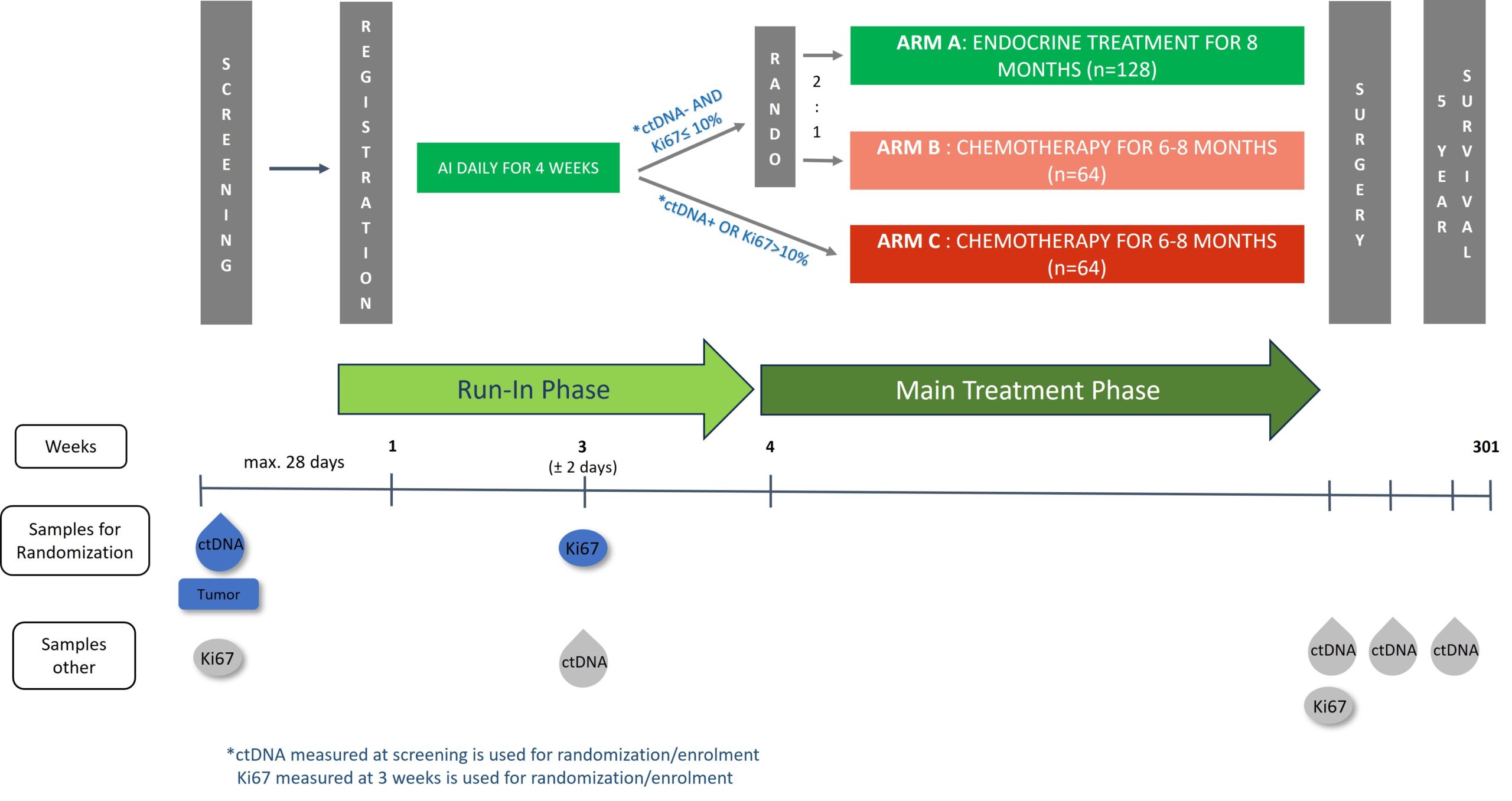
| Study Design: (Click to enlarge) |
 |
Treatment:
Participants receive 4 weeks of Aromatase Inhibitors (AI) in the initial Run-in Phase, followed by 2:1 randomization in arm A or B or enrolment in arm C in the Main Treatment Phase, depending on ctDNA-concentration and Ki-67 value of the participant. CtDNA-concentration is measured centrally by Natera with the SignateraTM-test, for which an (archived) tumor sample and blood are shipped at the beginning of the study. Ki-67 is evaluated locally after 3 weeks of AI therapy in the Run-in Phase.
If the measured ctDNA-concentration is max. 1 mean tumor molecule (MTM)/mL prior to treatment start AND Ki-67 is ≤10% after 3 weeks of AI, the participant is randomized 2:1 in arm treatment A or B:
- Arm A
AI for 6-8 months (+/- 30 days) as per Standard of Care. Switch to tamoxifen is allowed, if AI is not tolerated. - Arm B
Chemotherapy as per Standard of Care for 8 months (+/- 30 days)
Participants, whose ctDNA-concentration prior to treatment start exceeds 1 MTM/mL OR whose Ki-67 is > 10% after 3 weeks of AI will be enrolled in treatment arm C:
- Arm C
Chemotherapy as per Standard of Care for 8 months (+/- 30 days)
Primary Objective:
- To determine the efficacy of endocrine therapy vs chemotherapy in endocrine responsive patients with HR-positive, HER2-negative breast cancer and a ctDNA-concentration ≤ 1 MTM/mL, measured by modified preoperative endocrine prognostic index (PEPI) score.
Secondary Objectives:
- To determine the efficacy of endocrine therapy vs chemotherapy in endocrine responsive patients with a ctNDA-concentration ≤ 1 MTM/mL,measured by Residual Cancer Burden (RCB).
- To determine the difference in breast conservation turn-over rate (BCTOR) between endocrine therapy vs chemotherapy in endocrine responsive patients with a ctDNA-concentration ≤ 1 MTM/mL.
- To determine the efficacy of endocrine therapy vs chemotherapy in endocrine responsive patients with a ctDNA-concentration ≤ 1 MTM/mL measured by long-term outcome (invasive disease-free survival, invasive breast cancer-free survival, distant recurrence-free survival, and overall survival).
- To compare patient reported outcomes of neoadjuvant endocrine therapy vs chemotherapy in endocrine responsive patients with HR-positive, HER2-negative breast cancer and a ctDNA-concentration ≤ 1 MTM/mL, measured by EORTC QLQ-C30 and QLQ-BR42.
- To compare patient reported outcomes of neoadjuvant chemotherapy in endocrine responsive patients with a ctDNA-concentration ≤ 1 MTM/mL (arm B) vs chemotherapy in patients with a ctDNA-concentration > 1 MTM/mL or non-endocrine responsive patients (arm C) with HR-positive, HER2-negative breast cancer, measured by EORTC QLQ-C30 and QLQ-BR42.
- To compare patient reported outcomes in patients receiving different adjuvant therapy measured by EORTC QLQ-C30 and QLQ-BR42 after 1-year of follow up from surgery.
Safety Objectives:
- To determine the difference in Adverse Events (AEs) between endocrine therapy vs chemotherapy in endocrine responsive patients with a ctDNA-concentration ≤ 1 MTM/mL.
Exploratory Objectives:
- To evaluate the kinetics of ctDNA-detection across prespecified time points between treatment arms.
- To evaluate the association of kinetics of ctDNA-detection with surgical and long-term outcome.
- To determine the efficacy of endocrine therapy vs chemotherapy separately in patients with no detectable ctDNA vs patients with a ctDNA-concentration >0 to ≤ 1 MTM/mL.
Translational Objectives:
- To study additional research questions/ to perform additional analyses from biological material and/ or clinical data that have been collected within this study.
Patient Population
- The target population of this study consists of patients with ER+/HER2- early or locally advanced breast cancer (stage IIA-III per AJCC v8) with an indication for chemotherapy and no prior systemic breast cancer specific treatment.
- Participants will receive treatment in the Main Treatment Phase based on their ctDNA-status, assessed at the beginning of the trial, measured centrally with the SignateraTM-test and their endocrine response, assessed through the Ki67-value after 3 weeks of initial AI therapy (for details refer to „Treatment“).
* Study information is displayed as described in study protocol V2.0. Sites must adhere to the currently approved local version..
Share on