




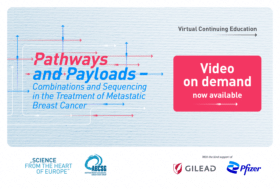
On-demand video now available
International Webinar “Pathways and Payloads – Combinations and Sequencing in the Treatment of Metastatic Breast Cancer”
The ABCSG virtual educational webinar “Pathways and Payloads – Combinations and Sequencing in the Treatment of Metastatic Breast Cancer”, which was moderated by ABCSG President Michael Gnant took place on September 24, 2026. The webinar attracted broad international participation, with attendees from 13 countries.
Part 1 covered endocrine combination strategies and the sequencing of antibody-drug conjugates (ADCs) in metastatic breast cancer.
Christian Singer (ABCSG Vice President, Medical University of Vienna, Austria) presented endocrine triple combination strategies, focusing on data from three different treatment approaches. VIKTORIA-1 evaluates gedatolisib in combination with palbociclib and fulvestrant in patients with PIK3CA wild-type disease after prior CDK4/6 inhibitor treatment. INAVO120 investigates inavolisib combined with palbociclib and fulvestrant in patients with PIK3CA-mutated, endocrine-resistant disease. The persevERA trial compares giredestrant plus palbociclib with letrozole plus palbociclib in the first-line setting.
Hope Rugo (City of Hope Comprehensive Cancer Center, USA) addressed the sequencing of ADCs in HR-positive/HER2-negative disease, covering data on sacituzumab govitecan after endocrine therapy and CDK4/6 inhibitor failure, datopotamab deruxtecan in TROPION-Breast01, and trastuzumab deruxtecan in HER2-low and HER2-ultralow HR-positive disease based on DESTINY-Breast06. The presentation also addressed where these ADCs may fit within the treatment sequence.
The first session concluded with a panel discussion and audience Q&A. The speakers were joined by Caroline Preuß (Kepler University Hospital Linz, Austria), Annette Reiner (Medical University of Innsbruck, Austria), and Gabriel Rinnerthaler (ABCSG Vice President, Medical University of Graz, Austria).
Part 2 focused on treatment strategies in HER2-positive and triple-negative metastatic breast cancer.
Rupert Bartsch (Medical University of Vienna, Austria) explored maintenance strategies in HER2-positive disease and the potential of bringing treatments into earlier lines, with a particular focus on the role of tucatinib in earlier treatment settings and data from the PATINA and HER2CLIMB-05 studies.
Marija Balic (University of Pittsburgh School of Medicine, USA) examined the potential of moving ADCs into the first-line treatment of metastatic triple-negative breast cancer, with a focus on data from ASCENT-04, ASCENT-03, and TROPION-Breast02. The presentation addressed the potential of ADCs to replace chemotherapy in the first-line setting and the question of which ADC should be used for patients with metastatic TNBC.
A second panel discussion and audience Q&A brought together the speakers and the discussants to consider the clinical implications of these evolving treatment strategies.
The webinar concluded with a wrap-up and closing by Michael Gnant.
The educational event was approved for 3 continuing medical education credits from the Austrian Medical Chamber (“DFP-Punkte”).
ABCSG would like to thank Gilead and Pfizer for their support of the educational webinar.
For those who missed the live event, the full on-demand video is now available in the → ABCSG Members Area.
With the kind support of

09.10.2026
Share on